Patch Alignment
A block graph specifies the boundary bases of each patch and how blocks and pipes connect. It leaves the physical placement of the stabilizers to the compiler. Before constructing circuits, we need a shared convention for the bulk \(X/Z\) checkerboard and the weight-two stabilizers along patch boundaries. This patch alignment makes neighboring patches compatible on the same qubit lattice.
This chapter introduces the alignment conventions, explains why Bloq uses fixed bulk alignment, and gives the coordinates used by the Circuit Constructions.
Two alignment conventions
An ordinary rotated surface code patch has weight-four stabilizers in its interior and weight-two stabilizers on its boundaries. Opposite boundaries share a basis, and adjacent boundaries have opposite bases. Exchanging the boundary bases therefore raises a physical design choice: keep the stabilizer supports in place and exchange their bases, or keep the bulk checkerboard and move the boundary stabilizers.
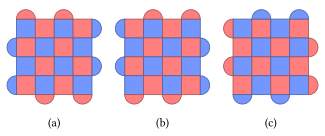
Patch alignment conventions. (a) Fixed bulk alignment with a top \(X\) boundary. (b) Fixed boundary alignment with a top \(X\) boundary. (c) A top \(Z\) boundary, for which the two illustrated conventions coincide. Comparing (a) with (c) keeps the bulk coloring and moves the boundary stabilizers. Comparing (b) with (c) keeps the stabilizer supports and exchanges their bases. Red denotes \(X\) stabilizers; blue denotes \(Z\) stabilizers.
With fixed boundary alignment, stabilizer supports stay in place when \(X\) and \(Z\) are exchanged. A transversal Hadamard exchanges their bases without requiring boundary realignment. However, neighboring patches can then have different bulk checkerboards. Joining them in a spatial junction can require stretched stabilizers to match the two patterns.
With fixed bulk alignment, each bulk plaquette’s basis is determined by its position on the lattice. Changing the boundary bases moves the weight-two boundary stabilizers while leaving the interior coloring unchanged. Spatially joined patches share a checkerboard, but Hadamard interfaces need additional circuit design to preserve that convention.
Convention |
What stays fixed when boundary bases exchange? |
Circuit consequence |
|---|---|---|
Fixed bulk |
Bulk checkerboard |
Ordinary spatial junctions share a checkerboard; Hadamard interfaces need realignment or domain-wall circuits |
Fixed boundary |
Stabilizer supports |
Transversal Hadamards preserve supports; some spatial junctions need stretched stabilizers |
Why Bloq uses fixed bulk
Bloq’s current circuit realization uses fixed bulk alignment, giving ordinary lattice-surgery junctions a shared checkerboard. The additional work belongs to the Hadamard constructions:
A temporal Hadamard realigns the stabilizer supports before applying transversal Hadamard gates. The basis exchange then restores the global checkerboard.
A spatial Hadamard joins patches across a basis-exchanging domain wall using extended stabilizer checks.
Note
The block compiler architecture supports adding other patch alignment conventions and circuit techniques, such as diagonal hook alignment. Fixed bulk is the current choice because its circuit constructions are more mature and easier to implement. We expect to extend Bloq with selectable alignment conventions and circuit realizations in future versions.
Coordinates and spacing
Bloq places patches compactly, leaving one row or column of data qubit sites between neighboring patches. Physical coordinates use a doubled square lattice, with \(y\) increasing upward. For a standard distance-\(d\) patch:
Quantity |
Convention |
|---|---|
Data qubits |
Both coordinates odd, from 1 through \(2d-1\) locally |
Stabilizer ancillas |
Both coordinates even |
Full footprint, including boundary ancillas |
\((2d+1)\times(2d+1)\) lattice sites |
Neighboring block-cell offsets |
\(2d+2\) along either spatial axis |
Surgery seam |
One intervening row or column of data sites |
The footprint counts lattice sites, not occupied qubits. An ordinary isolated patch contains \(d^2\) data qubits and \(d^2-1\) stabilizer ancillas; boundary sites without stabilizers remain unoccupied.
For example, at \(d=5\) the local data coordinates are \(1,3,5,7,9\) on each axis. The full footprint runs from 0 through 10, and the next block cell starts at offset 12. Seam data can occupy the intervening coordinate 11 when the patches join.
flowchart LR
  left["Patch A<br/>local sites 0…2d"] --- seam["Seam data<br/>2d+1"]
  seam --- right["Patch B<br/>offset 2d+2"]
The same coordinates define one global checkerboard. For an ancilla at global position \((x,y)\), the bulk basis is
Both ancilla coordinates are even, so \((x+y)/2\) is an integer. At Bloq’s supported odd distances, translating by one block-cell offset \(2d+2\) changes this integer by \(d+1\), which is even. Neighboring block cells therefore retain the same checkerboard phase. The comparison figure above uses a translated, vertically reflected drawing frame; the formula above defines Bloq’s physical coordinates.