T State Cultivation
This tutorial shows how to compile an isolated T block and assess its prepared state. Use the state in a Logical T Gate for gate teleportation.
Build and compile
The source needs one T block and one output port. Its pipe carries the prepared patch forward in time:
import bloq


def build_program() -> bloq.Bloq:
    """Build and save the T-to-Port source and its distance-11 compiled IR."""
    source = bloq.BlockGraph()
    source.add_block(bloq.Block((0, 0, 0), "T"))
    source.add_block(bloq.Block((0, 0, 1), "Port"))
    source.add_pipe(bloq.Pipe((0, 0, 0), "+Z"))
    source.validate()
    source.save("t-source.blog")

    program = bloq.compile(source, distance=11)
    program.save("t-source.bloqir")
    return program
The IR retains the output patch and a cultivation retry region. Physical
postselection failures or either logical observable’s decoder Flip trigger a
retry. Whole-program Stim emission cannot represent this non-Clifford protocol.
Cultivated state calibration
Add ten memory rounds after escape and growth to represent the decoding latency. Clifft samples the physical T circuit, while its Clifford companion supplies PyMatching’s detector error model. Ideal terminal stabilizer measurements close the decoding problem.
We compute the corrected logical expectations for the accepted-state infidelity:
Use Python 3.12 or newer and install Clifft and the GAP-enabled PyMatching build:
uv add "bloq-py==0.1.1" clifft "pymatching @ git+https://github.com/inmzhang/PyMatching.git@de4bb3e0796c1c9873d3ed5d1704364db10592cb"
The full script samples in batches and reports acceptance and infidelity for each GAP threshold:
"""Calibrate an isolated T state with Clifft and PyMatching complementary gaps."""

from __future__ import annotations

import argparse
import math
from collections.abc import Sequence

import clifft
import numpy as np
from numpy.typing import NDArray
import pymatching
import stim

import bloq


def build_program() -> bloq.Bloq:
    """Build and save the T-to-Port source and its distance-11 compiled IR."""
    source = bloq.BlockGraph()
    source.add_block(bloq.Block((0, 0, 0), "T"))
    source.add_block(bloq.Block((0, 0, 1), "Port"))
    source.add_pipe(bloq.Pipe((0, 0, 0), "+Z"))
    source.validate()
    source.save("t-source.blog")

    program = bloq.compile(source, distance=11)
    program.save("t-source.bloqir")
    return program


def parity(measurements: NDArray[np.uint8], columns: Sequence[int]) -> NDArray[np.uint8]:
    """XOR the selected measurement columns, returning one bit per shot."""
    return np.bitwise_xor.reduce(measurements[:, columns], axis=1)


def close_output(
    artifacts: bloq.IsolatedTAttemptArtifacts,
) -> tuple[stim.Circuit, stim.Circuit, list[list[int]]]:
    """Restore the output-Port closure omitted from the factory-only export.

    Return the closed decoder circuit, terminal MPP, and prior record columns.
    """
    companion = stim.Circuit(artifacts.companion)
    records: dict[int, list[stim.GateTarget]] = {}
    paulis: dict[int, list[stim.GateTarget]] = {}
    for instruction in stim.Circuit(artifacts.sheets):
        observable = int(instruction.gate_args_copy()[0])
        targets = instruction.targets_copy()
        table = records if all(t.is_measurement_record_target for t in targets) else paulis
        table.setdefault(observable, []).extend(targets)
    ids = artifacts.manifest.frontier_observables
    if set(records) != set(ids) or set(paulis) != set(ids):
        raise ValueError("terminal stabilizer sheets are incomplete")

    # Each frontier sheet supplies one stabilizer product for the ideal MPP.
    targets = []
    for observable in ids:
        for index, target in enumerate(paulis[observable]):
            if index:
                targets.append(stim.target_combiner())
            targets.append(target)
    terminal = stim.Circuit()
    terminal.append("MPP", targets)
    closed = companion + terminal
    # Shift earlier rec[-k] references past the newly appended measurements.
    for index, observable in enumerate(ids):
        closed.append("DETECTOR", [
            *(stim.target_rec(t.value - len(ids)) for t in records[observable]),
            stim.target_rec(index - len(ids)),
        ])
    columns = [[companion.num_measurements + t.value for t in records[o]] for o in ids]
    return closed, terminal, columns


def prepare(
    program: bloq.Bloq,
) -> tuple[
    clifft.Program,
    pymatching.GapDecoder,
    bloq.IsolatedTAttemptManifest,
    list[int],
    list[list[int]],
]:
    """Append memory rounds and prepare the noisy simulator and GAP decoder."""
    [(path, body)] = [(p, b) for p, b in program.levels() if p]
    program.insert_memory_rounds_after(body.quantum_tail(), rounds=10, path=path)
    # This calibration export keeps the T circuit and Clifford DEM records aligned.
    artifacts = bloq.emit_isolated_t_attempts(program, noise=1e-3)
    manifest = artifacts.manifest
    closed, terminal, columns = close_output(artifacts)
    dem = closed.detector_error_model(decompose_errors=True)

    # Condition ordinary matching on the physical postselection checks passing.
    postselection = set(manifest.postselection_detectors)
    conditioned = stim.DetectorErrorModel()
    for instruction in dem.flattened():
        if instruction.type != "error":
            conditioned.append(instruction)
            continue
        for group in instruction.target_groups():
            if not any(t.is_relative_detector_id() and t.val in postselection for t in group):
                conditioned.append("error", instruction.args_copy(), group)
    conditioned.append("detector", [], [
        stim.target_relative_detector_id(closed.num_detectors - 1),
    ])
    observables = [manifest.gap_x_observable, manifest.gap_z_observable]
    decoder = pymatching.GapDecoder(
        conditioned, observables=observables, enable_correlations=False,
    )
    simulator = clifft.compile(
        artifacts.physical_t + "\n" + str(terminal),
        postselection_mask=[int(i in postselection)
                            for i in range(len(manifest.detector_signs))],
        expected_detectors=list(map(int, manifest.detector_signs)),
    )
    return simulator, decoder, manifest, observables, columns


def calibrate(program: bloq.Bloq, shots: int) -> None:
    """Sample attempts in bounded batches and print statistics for each GAP cut."""
    simulator, decoder, manifest, observables, columns = prepare(program)
    thresholds = np.arange(21)
    counts = np.zeros(len(thresholds), dtype=np.int64)
    totals = np.zeros(len(thresholds))
    squares = np.zeros(len(thresholds))
    attempts = 0
    clifft.set_num_threads(1)
    for start in range(0, shots, 1024):
        sample = clifft.sample_survivors(
            simulator, shots=min(1024, shots - start), seed=7 + start, keep_records=True,
        )
        attempts += sample.total_shots
        if sample.passed_shots == 0:
            continue
        # Compare the last noisy syndrome records with the ideal output MPP.
        terminal_bits = sample.measurements[:, -len(columns):]
        frontier = np.column_stack([
            parity(sample.measurements, c) ^ terminal_bits[:, i] ^ int(manifest.frontier_signs[i])
            for i, c in enumerate(columns)
        ])
        syndromes = np.column_stack([sample.detectors, frontier]).astype(np.uint8)
        predictions, _, _, gaps = decoder.decode_batch_with_weights(syndromes)
        # Correct each measured frame parity using its associated GAP prediction.
        frame_x = (parity(sample.measurements, manifest.frame_x_measurements)
                   ^ int(manifest.frame_x_sign)
                   ^ predictions[:, observables.index(manifest.frame_x_gap_observable)])
        frame_z = (parity(sample.measurements, manifest.frame_z_measurements)
                   ^ int(manifest.frame_z_sign)
                   ^ predictions[:, observables.index(manifest.frame_z_gap_observable)])
        corrected = sample.exp_vals * np.asarray(manifest.exp_val_signs)
        # X anticommutes with the Z frame; Y anticommutes with both frames.
        # Only these two expectations enter the T-state infidelity.
        corrected[:, 0] *= 1 - 2 * frame_z.astype(float)
        corrected[:, 1] *= 1 - 2 * (frame_x ^ frame_z).astype(float)
        infidelity = np.clip(
            (1 - (corrected[:, 0] + corrected[:, 1]) / math.sqrt(2)) / 2, 0, 1,
        )
        for i, threshold in enumerate(thresholds):
            # Both logical bases must pass the same cut. Keep their sample moments.
            accepted = infidelity[np.all(gaps >= threshold, axis=1)]
            counts[i] += len(accepted)
            totals[i] += accepted.sum()
            squares[i] += np.square(accepted).sum()

    print("GAP threshold,acceptance,infidelity,95% half-width")
    for threshold, count, total, square in zip(thresholds, counts, totals, squares, strict=True):
        mean = total / count if count else float("nan")
        half_width = float("nan")
        if count > 1:
            variance = max(0, square - total * mean) / (count - 1)
            half_width = 1.96 * math.sqrt(variance / count)
        print(f"{threshold},{count / attempts:.6g},{mean:.6g},{half_width:.6g}")


def main() -> None:
    """Read the shot count and run calibration after building the source."""
    parser = argparse.ArgumentParser(description=__doc__)
    parser.add_argument("--shots", type=int, default=10_000)
    args = parser.parse_args()
    if args.shots <= 0:
        parser.error("--shots must be positive")
    calibrate(build_program(), args.shots)


if __name__ == "__main__":
    main()
Download the script and run:
uv run python tutorial_t_cultivation.py
The default is 10,000 attempts. Use --shots to change the sample size.
Simulation Results
At physical error probability \(p=0.001\), each point below used 20 million attempts. Infidelities are conditioned on acceptance. Uncertainties are nominal pointwise 95% half-widths, in units of \(10^{-6}\).
Distance |
GAP threshold |
Acceptance |
Accepted infidelity \((\times10^{-6})\) |
|---|---|---|---|
5 |
12 |
31.319105% |
\(6.386 \pm 1.517\) |
7 |
11 |
39.447890% |
\(7.985 \pm 1.561\) |
9 |
11 |
40.051925% |
\(7.865 \pm 1.528\) |
11 |
11 |
40.120605% |
\(6.730 \pm 1.403\) |
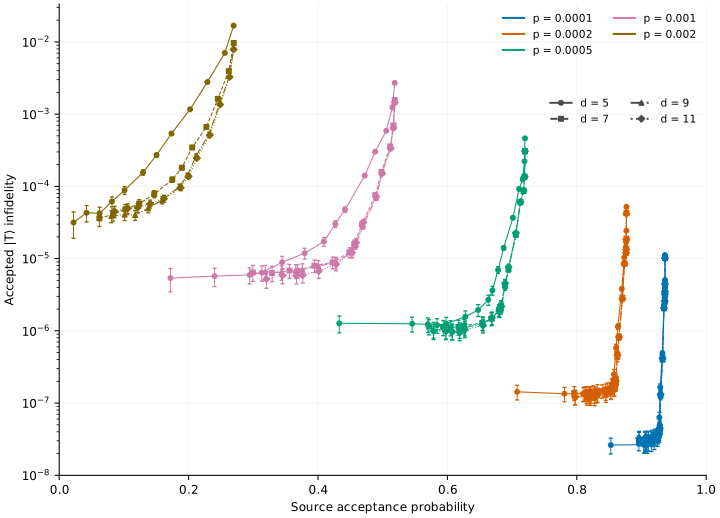
For a Logical T Gate or CCZ factory, retain the source’s acceptance and full error model. Infidelity alone is insufficient.